Solace in the City: Fostering Peace in the Tech Noise
A guest post about our relationship with technology

Hi friends,
This week I have something special for you! A graduate student from Columbia University wrote an article about me! It covers our relationship with technology, my book Quietest Places in New York City, and the Quiet Car. It is written by is Lauren Johnson. Without further ado…
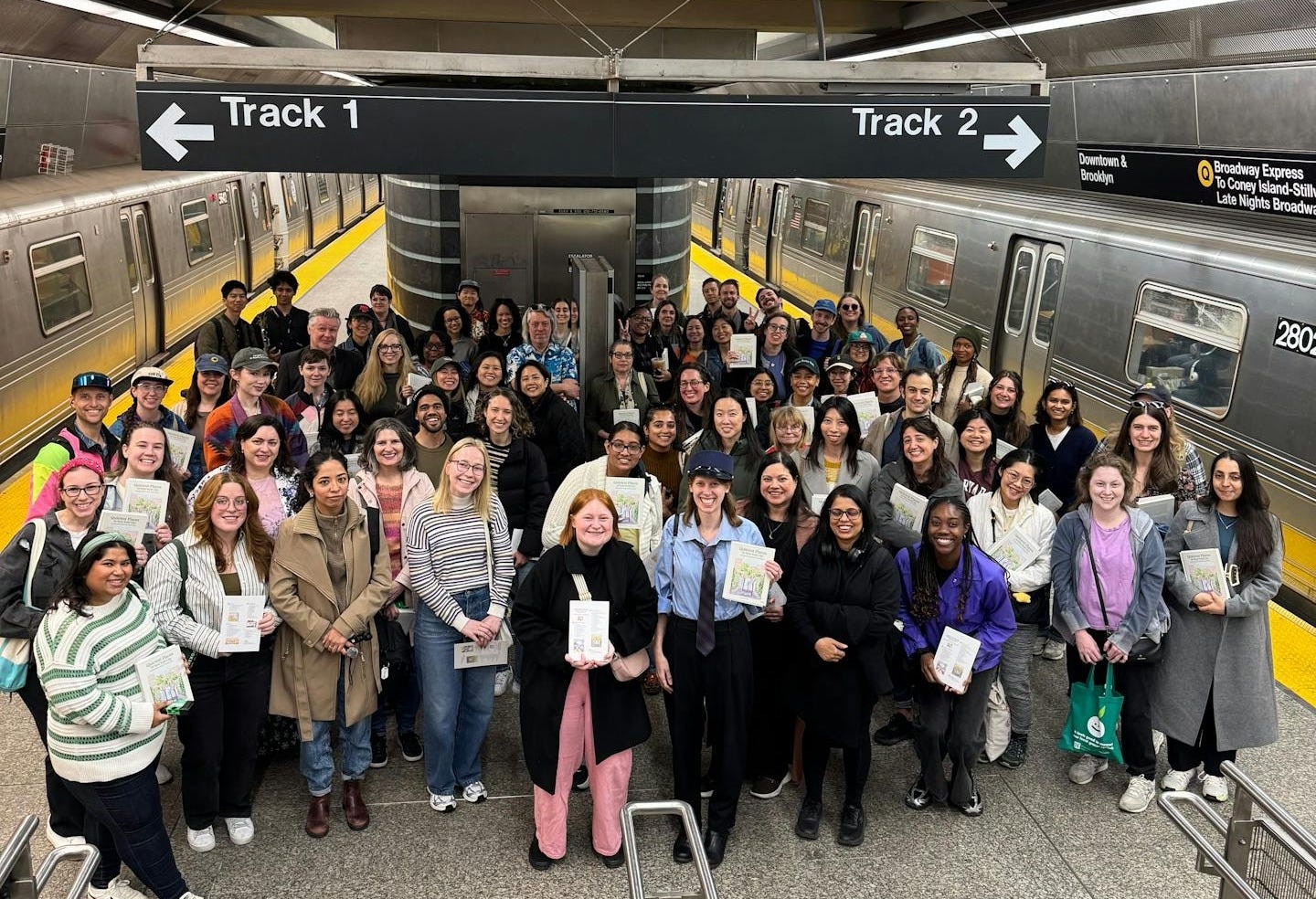
“The train is about to start moving,” said NYC-based therapist Alysia Sobhraj. “There’s nothing you need to do about that.” As the Q train departed southbound from the 96th Street station on a Saturday morning in Manhattan’s Upper East Side, a car-full of participants finished their five minute meditation with a collective deep breath. Then they made sure that their phones were put away for the 20 minute ride to Canal St.
“I spend a lot of time on the train, noticing how sad it is that everybody’s just locked in on their phones,” said Brooklyn resident Spencer Foster, one of the many attendees at the Turn the Q Train Quiet event organized by Nicole Kelner and her publisher Rizzoli on April 11.
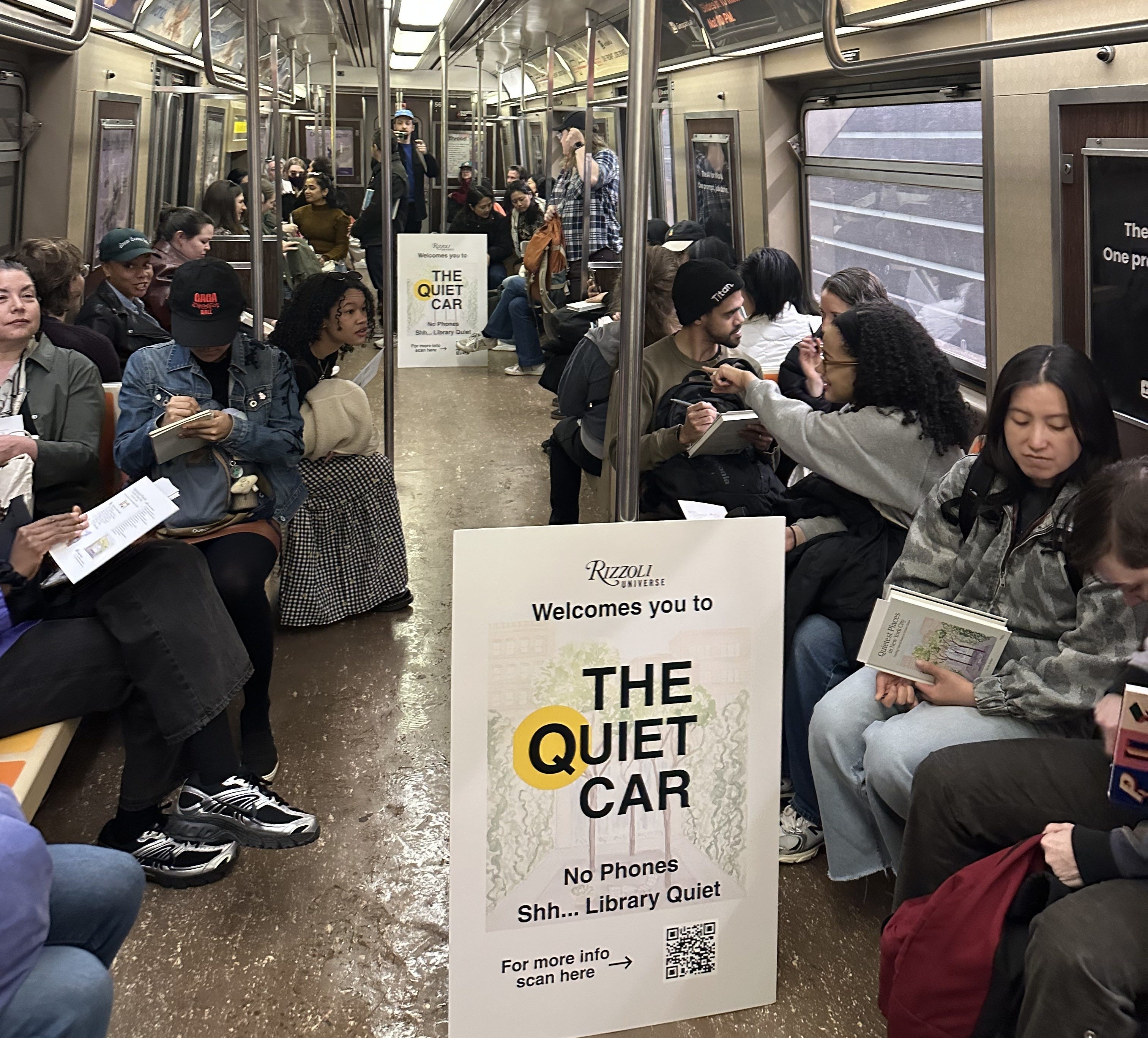
“I’m always wondering what it was like 80 years ago. Maybe they were talking or doing things or interacting more,” said Foster. For the ride, participants were encouraged to bring their favorite non-tech activity. Foster was focused on his current zine project, aimed at reviewing books and movies outside of online platforms. Further down the car, a woman in a red blouse read a graphic novel. As the train jolted along the tracks on the way to Canal St., the passengers remained intent on their activities.
Attendees came to the event for many reasons – to connect with others in a low-pressure environment, to get out of the house, or even to feel like they were a part of an improv-esque event. But for others, this desire to connect with people away from technology was key.
Almost half of 18 to 29-year-old Americans reported being nearly constantly online in a 2021 Pew Research Center study. For Dr. Devon Sandel-Fernandez, a clinical psychologist and professor at the University of Washington School of Medicine, this is especially concerning because of the way that technology can interact with our brains. According to Dr. Sandel-Fernandez, many of the most popular apps tap into our brains’ reward systems by triggering the release of dopamine, doing so with similar tactics that draw people into gambling addiction.
Dr. Sandel-Fernandez has seen a wide range of impacts from tech overuse with her patients, from online shopping addiction on social media apps, to social isolation when social media and AI chatbots start to replace real-life interactions. “We get a hit of dopamine, and our brain says, ‘Do that thing again. Do that thing again. Do that thing again,’” she said, which can lock people in a cycle of technology use.
Q Train event leader and Prospect Park resident Nicole Kelner is seeking to reclaim attention from her phone, and to encourage others to do it, too. She recently released a new tech mindfulness app and published a book of watercolor paintings and guides to her favorite peaceful places, The Quietest Places in New York City.
“I’ve always wanted to make an impact in the world,” said Kelner. “As long as I’m working on something that I feel like is making a positive impact in the world, I’m happy.”
Kelner traces her desire to fix problems to her dad. “He calls himself a MacGyver,” she smiles. “We definitely bond on that problem-solving nature of, ‘Okay, this is broken. I want to fix it right now, and I won’t stop until it’s fixed.’”
As an adult, her desire to make an impact first came to life in her work in education. In 2015, Kelner co-founded the children’s coding camp The Coding Space in New York City. There, she started to notice a tension with the campers and technology. On one hand, technology helped her build connections with the campers. During the summer of Pokemon Go, they bonded over catching Pokemon together. But she also remembers feeling some trepidation watching children interacting with technology so extensively.
“I thought, if we don’t create systems to help them use their technology mindfully, we’re gonna have a problem. Fast forward – we’ve got a problem.” While Kelner saw students learning valuable technical skills in a structured way in her program, she worried about how technology would impact their mental health where there were less guardrails.
For clinical psychologist Dr. Sandel-Fernandez, she noticed concerning tech use behaviors with her younger patients similarly around 10 years ago. But as time has passed and smartphones have become more prevalent throughout society, the problem has spread to patients of all ages. “I wouldn’t make any assumptions anymore [based on age] about who may or may not be struggling with technology overuse in my office,” she said.
When Kelner herself felt the consistent tug to unwillingly spend time on her phone, she coded and released the app Free Time in November 2025. The app “locks” tempting apps and prompts users to complete a meditation exercise before opening them, with the goal of enabling them to use them more mindfully.
When her Substack post about her favorite quiet places snowballed into the fully illustrated book The Quietest Places in New York City published in February, she intentionally integrated guidance on how to use technology mindfully when visiting.
“I kind of framed the book as an invitation to take out your AirPods, turn off your phone, and just find that quiet,” said Kelner.
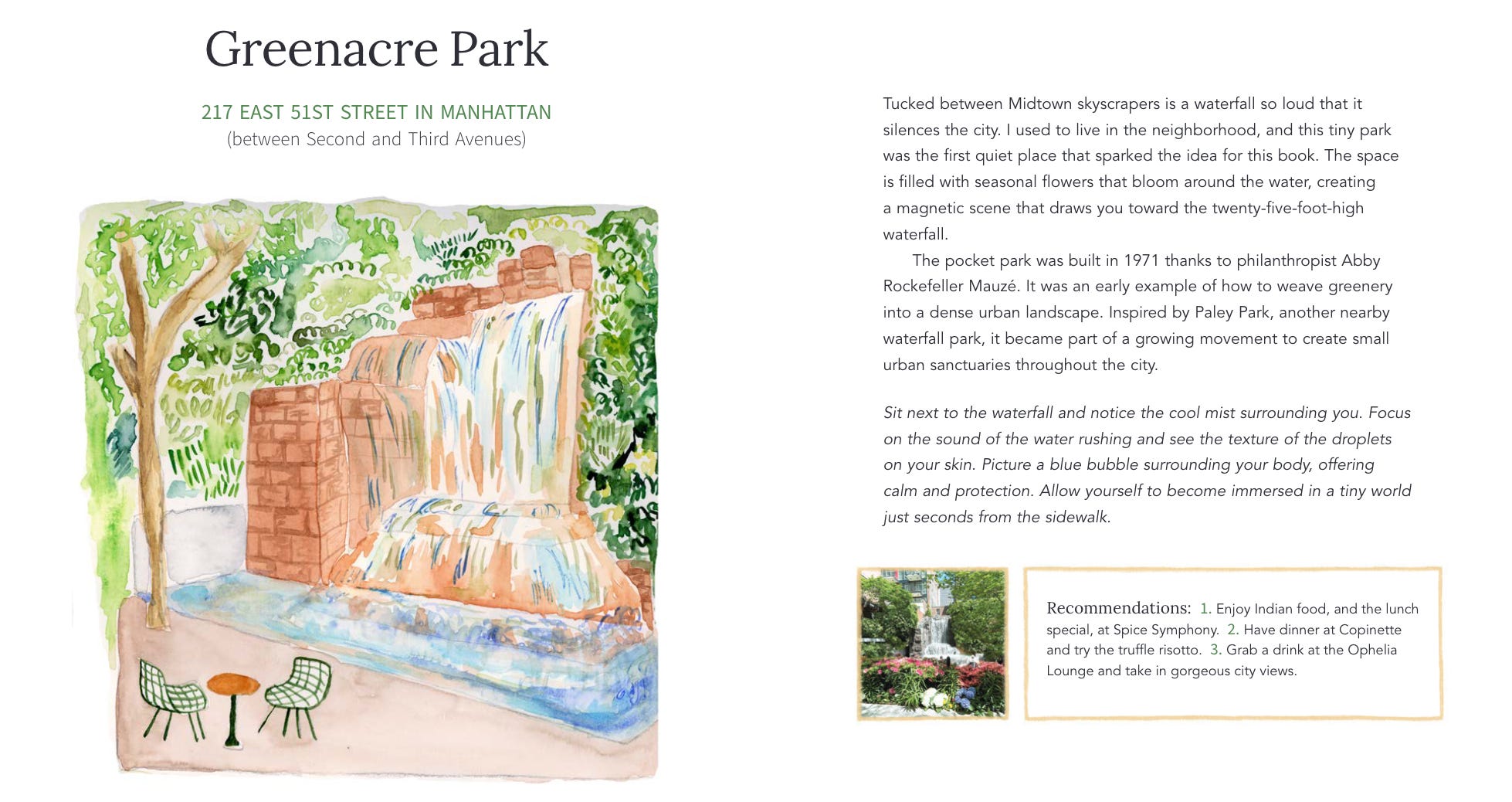
For Kelner, the constant noise of New York City and of technology have pushed her to seek out quietness where she can and share it with others. The idea to share a list of her favorite quiet places came to life for her in Greenacre Park, a small park in New York City. “You’re next to this beautiful waterfall in the middle of Midtown, and you can’t hear anything but the rushing water,” she said. “It’s crazy. I was like, I needed this more than I know. Just to be able to have this peace and calm was a game changer.”
Nicole Kelner’s work to help New Yorkers connect with themselves and others away from technology exists in a vast ecosystem in the city. Through his newsletter NYC Off Tech, Nick Plante shares events like Nicole’s to a growing group of New Yorkers – from the tech-mindfulness-curious to the self-proclaimed Luddite – that are interested in connecting with others in person, and without a phone in sight.
“It’s really hard for people our age to step away,” said Plante.
Plante’s desire to help others reduce their phones’ influence on their lives comes from his experience as a member of Gen Z. Plante got his first smartphone in middle school. In high school, he began noticing that something was wrong.
“I felt like the things that I wanted to see myself do, and the way that I wanted to be, was compromised by this very addicting technology,” he said.
He’s tried more than most to limit his phone’s grip on his time and attention. In college, he once locked his phone in a storage locker for a month during the pandemic. He even embarked on an unheard of phone-free road trip with friends for several weeks. He now takes the less drastic approach of using a “dumb phone” called the Light Phone, which has less potentially time-sucking functionality than a smart phone.
Through his newsletter NYC Off Tech, he shares a plethora of events meant to sideline technology and center human connection. They range from Nicole Kelner’s Q Train event to a self-organized party series called “Let’s Get Off Together” where party-goers found themselves dancing on a cardboard replica of a data center in April.
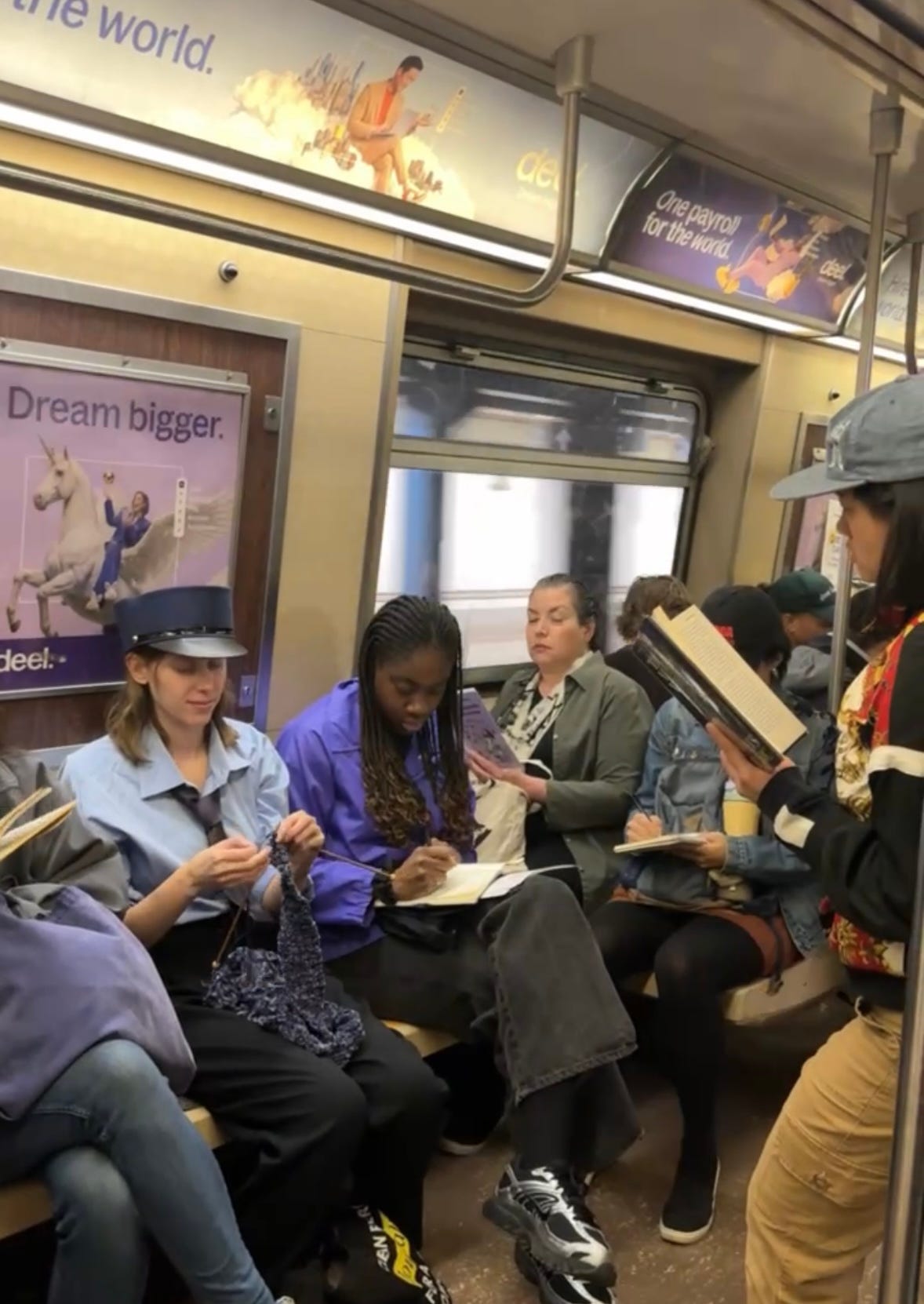
Back on the Q Train, as it rocketed downtown beneath the constant motion New York City, Nicole Kelner sat contentedly. Throughout the car, most read hard cover books. Two women whispered over a crossword, and a young man asked people to contribute words to a collective poem. Non-participants entered the train as it barreled downtown. Their conversations quieted to whispers, and phones began to look peculiar.
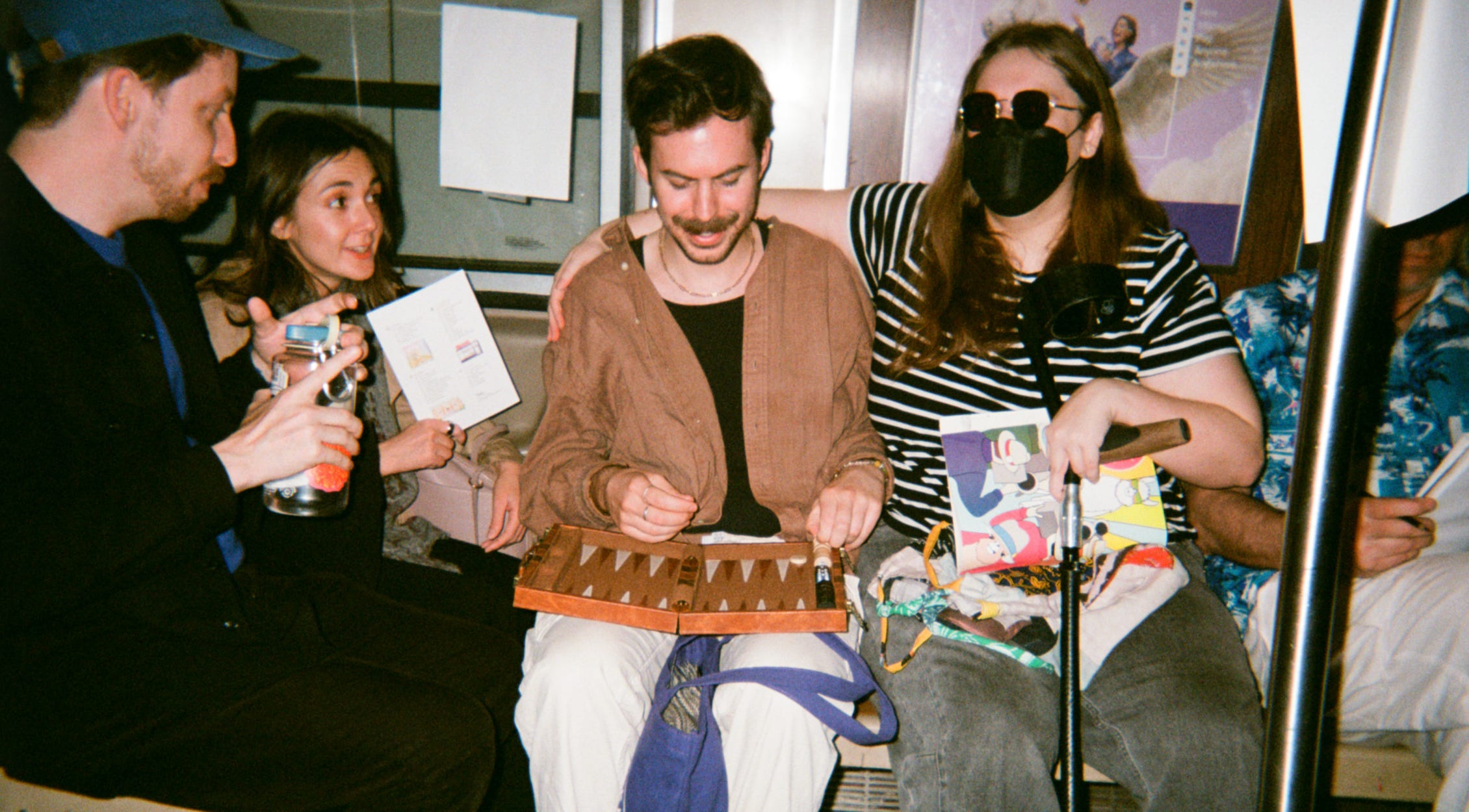
For attendee Doris Pu, a 33-year-old living in Long Island City, Kelner’s event provided a supportive environment to unplug together. “Like most people, I’m kind of addicted to my phone,” said Pu. “Usually, if you go on the subway, every single person’s looking at their phone, right?”
“To be surrounded by people who are also doing the same thing is quite nice,” said Pu. “We’re all in this together and trying to be more intentionally kind and mindful and free.”
The ads in the train around Kelner implored efficiency, progress – to “dream bigger” through a new software for businesses. Wearing a conductor’s hat and suit, she surveyed the crowd, looked back down to her knitting project, and smiled.
About the writer
Lauren Johnson is an NYC-based sustainability professional and student. She’s currently completing a Sustainability Management master’s degree at Columbia University. When she’s not working on food system and consumer goods sustainability, she loves cooking, reading, enjoying live music and city life in NYC, and thinking critically about our relationship with technology.
Upcoming Events
The Quiet Car- The first one was such a hit, we’re doing it again! No phones allowed! Bring your favorite analog activity (reading, drawing, knitting, writing, etc) and let’s enjoy being quiet together. The event is free and everyone will get a free copy of my book, Quietest Places in New York City. June 27th at 11am. RSVP here.
Climate Art 101- the next cohort starts June 22nd. If you want to learn how to use art as a tool for climate communications and tap into your creativity, you can learn more here.